

A provably fair round can be examined retrospectively using the commitment and revealed inputs rather than the plane's animation. The following conditional example documents the calculation so that a reader can compare a completed round in their own history with its disclosed values.

Verification asks whether a completed round agrees with the information disclosed about it. The pre-round commitment is not a prediction: the relevant seed and round data become available for the retrospective calculation. The formula, worked value and limits of that check are presented below as distinct steps.
A simple demonstration represents an increasing multiplier and an endpoint. It can use fixed illustrative values or a fictional point balance to teach the distinction between exposure and return. It does not have to recreate a commercial product's software. No actual bank account, identifiable wallet or payment instrument is involved. If a page instead prompts you to register with a betting platform or to deposit funds, it is no longer the cash-free lesson described here.
There are three logically separate checks. First, comparing the revealed server seed with the earlier SHA-256 commitment addresses whether that value reproduces the prior digest. Second, computing the combined SHA-512 digest depends on knowing the precise sequence and encoding of all four input values. Third, converting the first 13 hexadecimal digits to an integer and applying the published arithmetic should reproduce the displayed multiplier under the same rounding convention. A match at one of these stages is not a substitute for the other two.
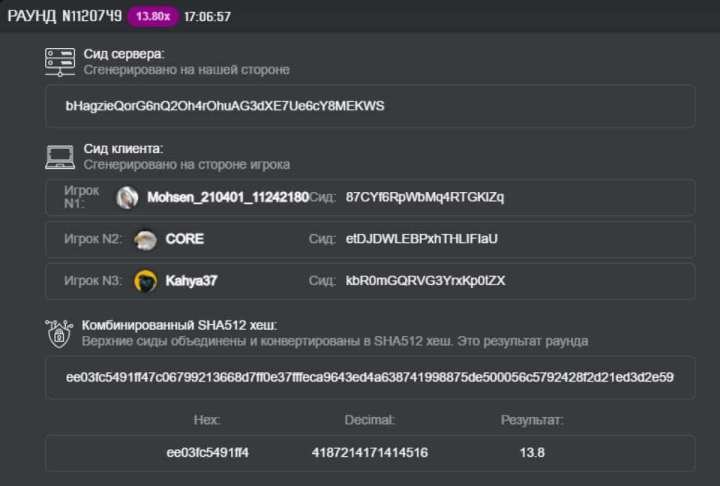
The original material preserves a captured prefix, ee03fc5491ff4, and reports 13.80×. Its hexadecimal-to-decimal conversion and the stated multiplier calculation agree. The training table separately reports ee02c761243b4, and its stated integer and rounded multiplier are also arithmetically consistent. However, reproducing this second digest requires the original input representation. Directly joining the published four printed seed values without a separator gives 4ec480e1fde2e instead. This result corresponds to h = 1,385,694,125,612,590 and 1.40×. We therefore retain the historical table as supplied while distinguishing its reported digest from the locally reproduced literal-concatenation example.
A reader who has recorded data for an actual round should compare values from that exact round; a seed from another entry cannot be substituted simply because the displayed multiplier was similar. A displayed coefficient rounded to two decimal places is not unique to a digest: different raw values may produce the same rounded result, as the two reported prefixes above demonstrate. Therefore equality of a rounded multiplier alone is weaker than matching the relevant commitment and documented inputs.
In a local tool, each field should contain only the disclosed seed string, not a title, surrounding quotation marks or extraneous spacing unless the provider explicitly specifies that representation. This is a calculation on an exact sequence of bytes. Different input strings create different digests, and the calculator must be interpreted according to the encoding and combination format documented for the actual game version. The worksheet below uses literal concatenation and labels that assumption instead of silently guessing a format.
Finally, a correctly reproduced round does not by itself verify whether a site is the original Spribe game, whether the operator is authorised locally, how an account is funded or whether a later withdrawal will be approved. Those are separate questions of product identity and casino service. The theoretical 97% RTP also remains a separate statistical property. No completed-round check establishes a method of predicting a future flight or changing the economic expectation.
The captured round #1120749 has the reported digest prefix ee03fc5491ff4, h = 4,187,214,171,414,516, which gives 13.80× using the published equation. The original training table separately reports ee02c761243b4, h = 4,187,131,238,040,500, also producing 13.80×. However, literal concatenation of its printed seed strings yields 4ec480e1fde2e, h = 1,385,694,125,612,590 and 1.40×. Therefore the original training data cannot be described as independently reproduced without confirmation of the exact input format.floor(2⁵² ÷ (2⁵² − h) × 0.97 × 100) ÷ 100
A commitment's value lies in its timing. If a server could choose the seed only after a round's stakes were known, an after-the-fact disclosure alone would not demonstrate that choice was unbiased. Publishing the seed's SHA-256 beforehand allows the later disclosure to be compared to an existing digest: producing a different seed with the same commitment is computationally impractical. This two-stage design is called commit-reveal.
A valid commitment supports the claim that the server did not undetectably substitute its seed after seeing the stakes. It does not imply a positive expected return, nor does it eliminate the published 97% RTP and corresponding 3% house edge. The verification and the game's financial mathematics answer different questions.
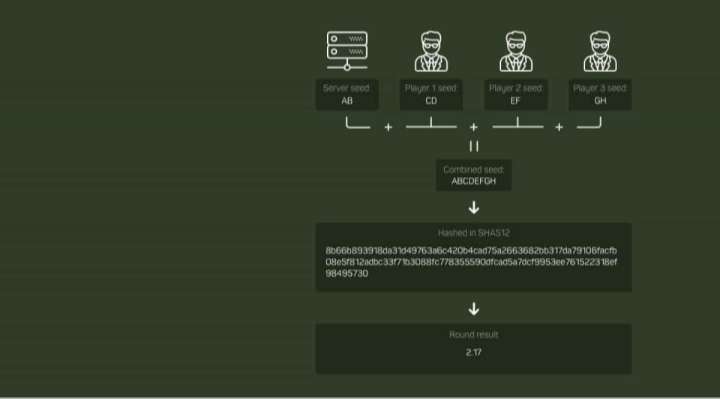
The server creates its random seed before the betting window and computes SHA-256. Only the digest is exposed at that point. A later seed substitution that preserves that digest would be computationally infeasible.
During the entry window, the first three participating clients supply their client seeds. The calculation therefore incorporates values originating on the player side as well as the server value.
When the flight has ended, the server seed is revealed. Including the three client seeds, all four relevant values become available for comparison with the commitment and multiplier calculation.
The documented combination of server and three client seeds is hashed using SHA-512. Interpret the digest's first 13 hex digits as h, then compute floor(2⁵² ÷ (2⁵² − h) × 0.97 × 100) ÷ 100. The multiplier formula includes the 0.97 factor expressing the declared 97% RTP.
Only the SHA-256 digest of the server value is published initially; the seed remains concealed.
The first three participating clients contribute their seeds to the documented input set.
After disclosure, the server seed and three client values comprise the four inputs available for retrospective calculation.
Combine the disclosed values, compute SHA-512, interpret the first 13 hex digits as h and use the multiplier formula to compare the completed result.
The following arithmetic uses standard SHA-256 and SHA-512 hash functions and can be reproduced from known inputs.

The 0.97 factor explicitly incorporates the game's declared return. Larger h values toward its upper bound produce larger multipliers; lower values occur much more commonly in the resulting distribution. A verifiable calculation and a 3% house edge are compatible: the latter is visible in the equation rather than removed by commitment verification.
0.97Concatenation, hashing and the hexadecimal conversion form the other parts of the calculation. The coefficient 0.97 describes the economic component. A matching hash therefore does not imply that gambling has a positive mathematical expectation.
Aviator crash point formula, editorial analysis · 11 Aug 2026
The illustrated flight #1120749 has the readable digest prefix ee03fc5491ff4, corresponding to h = 4,187,214,171,414,516 and a multiplier of 13.80×. The screenshot does not provide readable full seed strings; those values are not reconstructed or guessed here.
The source training table reports ee02c761243b4 and 13.80×. The decimal conversion and multiplier are internally consistent for that prefix, but concatenating the four printed training seeds literally yields 4ec480e1fde2e and 1.40×. The difference illustrates why an independently verified input format is necessary; the original reported values are retained as reference, not a reproduced seed example.
| Calculation stepAttribute | Training seed setPublished value |
|---|---|
| Server seed | DtpP8vUjdiMfn4dVbJt8bZhsdKT1qAz7iZCwXvZ0Revealed only after the crash |
| Three client seeds for the round | txcgzPAhctu2f4GzBUID · ZPISstqQiNNshsfrm12I · HLfMXKrqj4TOGYla5wcLThe first three players to bet in the round |
| SHA-512, first 13 hex characters | ee02c761243b4 |
| The same number h in decimal | 4 187 131 238 040 500 |
| Calculation | floor(2⁵² ÷ (2⁵² − h) × 0.97 × 100) ÷ 100 |
| Formula result | 13.80× |
The source training table reports ee02c761243b4 and 13.80×. The decimal conversion and multiplier are internally consistent for that prefix, but concatenating the four printed training seeds literally yields 4ec480e1fde2e and 1.40×. The difference illustrates why an independently verified input format is necessary; the original reported values are retained as reference, not a reproduced seed example.
Record the server-seed commitment displayed before the round. This is the independent reference against which the later seed disclosure can be compared.
Once the flight has stopped, locate the server seed and the three participating client seeds in the completed round's history or its provably fair panel.
Compute SHA-256 for the disclosed server seed using a trustworthy independent calculation. Avoid sending account details or unnecessary information to unfamiliar websites.
Compare that digest with the pre-round record character by character. A mismatch requires investigation; it does not validate the disclosed seed against the recorded commitment.
Apply the documented combination and SHA-512 calculation to the four values. The first 13 hexadecimal characters give h; evaluate the equation above and compare its rounded multiplier with the recorded stopping value. The training example uses the same steps.
Once disclosure has taken place, verification has the four inputs needed to reproduce a result. Before the next flight, the available server digest is not its seed, and client values from the other participants have not all been disclosed. Hash inversion is computationally impractical. This is why a completed-round check is not a prediction, as the separate predictor analysis explains. predictor debunking page
The cited Aviator construction instead uses a normal, non-keyed SHA-512 digest of the combined server and three client seeds. Some crash products use an HMAC-SHA-512 construction with a key and nonce message, but importing those terms into this particular Aviator equation gives the wrong method.
All disclosed flights can be evaluated with the same equation, including the visible 0.97 factor. That factor is a stated RTP parameter, not evidence that the multiplier was individually adjusted for a person's stake. The purpose of checking is to compare the disclosed inputs with the committed and displayed values.
Enter the disclosed round inputs from the verification panel to reproduce the multiplier and inspect the intermediate calculation steps.
The exact worked formula and original round example remain in the detailed guide.
It describes a commitment and later disclosure. SHA-256 commits the server seed before entry, and following the crash the seed is disclosed. The published multiplier arithmetic can then be reproduced from the relevant revealed inputs and compared to what the game displayed.
Use the disclosed server and three client seeds, combine them in the documented order and compute SHA-512. Interpret the first 13 hexadecimal digits as h, then evaluate floor(2⁵² ÷ (2⁵² − h) × 0.97 × 100) ÷ 100. Compare the result with the multiplier recorded for that flight.
The server seed is a random value committed through SHA-256 beforehand and disclosed after the crash. The first three participating players' client seeds contribute additional inputs from the player side.
Recording a hash in advance gives the later revealed seed an independently comparable reference. A seed selected or substituted afterward could not be accepted as matching unless it produced the previously recorded digest.
For a specific captured round with its actual commitment and disclosed inputs, a digest or calculated multiplier mismatch would be visible in the independent check. A history feed by itself is not an independent proof of every past result.
No. The cited construction uses SHA-256 for the server commitment and ordinary SHA-512 to derive the multiplier from combined values. HMAC-SHA-512 with a nonce appears in some other products and should not be substituted into this particular calculation.
Verification uses information made available once a particular flight is complete. Prediction promises a result before the necessary seed and client data are disclosed. The earlier digest does not provide those inputs. A separate article explains the limitation of prediction claims. debunking predictors
The instructional simulator demonstrates the same sequence: a SHA-256 commitment, disclosure of a seed after the simulated stop and the multiplier derived from the leading 13 digits of SHA-512. The model doesn't require a paid balance or account.
Because the browser generates the model's inputs without an independent operator, the simulator does not supply operator-level proof or replace verification of an actual recorded flight. It is a mathematical demonstration.

Spribe's stated 97% RTP is a long-run statistical figure, not a promised return from an individual session.
See the calculation in a local illustration with virtual credits.
Why unavailable inputs prevent forecasting the next stopping point.
Understand the expected cost of different exposure patterns.
Compare legitimate browser and mobile access routes.
The game's mechanic differs from reels and paylines.
Compare the documented features of JetX, Lucky Jet and Space XY.

A correctly reproduced multiplier does not establish whether an operator processes withdrawals as described. The separate operator reviews consider published cashier terms, dated evidence and the nature of payment complaints.
Read reviews